
1. Introduction
Health communication on social media comprises several behaviors with potentially beneficial and harmful implications. It includes searching for advice, exchanging personal experiences, interacting with people who face similar conditions, and watching health-related videos. These activities can widen access to practical knowledge and peer support, particularly when formal services are difficult to reach (Chen & Wang, 2021; Han et al., 2021; Naslund et al., 2020). The same activities can also place users in streams of conflicting claims, emotionally charged stories, and uncertain source cues. Accordingly, the central question is not whether social media is uniformly good or bad for health. It is how a particular pattern of health-related engagement covaries with psychological distress, through which cognitive resources, and under which technological and age conditions.
The distinction matters because evidence drawn from general social media use does not map automatically onto health communication. General use may affect well-being through social comparison, cyberbullying, displacement, or social connection (Chou & Edge, 2012; Kowalski et al., 2014). Health-related communication adds a different source of uncertainty: the stakes of interpreting symptoms, treatments, and personal risk. During crises, misleading or rapidly changing claims may intensify fear (Anwar et al., 2020; Apuke & Omar, 2021). Outside crises, repeated searching can still be entangled with health anxiety and distress (Te Poel et al., 2016). Heavy social media use and perceived information overload have likewise been associated with depressive symptoms and psychological distress (Matthes et al., 2020; Merlici et al., 2024; Mougharbel et al., 2023). These observational estimates describe contemporaneous covariance; temporal ordering requires repeated measurement.
One cognitive resource that may organize these mixed experiences is information-seeking self-efficacy: confidence in being able to find helpful health resources online. Repeated searching and exchange may provide practice and successful retrieval experiences, thereby strengthening confidence. Conversely, an unmanageable volume of inconsistent content can expose limits in a user’s search strategy and weaken confidence (Cao et al., 2016; Eastin & LaRose, 2000; Rains, 2008). Treating self-efficacy as a possible statistical intermediary therefore permits a more specific test than treating all online health activity as a direct psychological exposure.
Wearable health devices introduce another information channel. Activity trackers and smartwatches offer individualized, repeated feedback that may complement social media content, but they may also make additional social-media searching less consequential for confidence. Wearables can support self-monitoring and engagement, yet devices are facilitators rather than autonomous causes of behavior change (Kang & Exworthy, 2022; Patel et al., 2015). Their role in the communication–efficacy association is therefore an empirical question. Age further complicates this role because older and younger adults differ in technology access, experience, health needs, and patterns of device adoption (Chandrasekaran et al., 2021; Fowe & Boot, 2022; Kim & Choudhury, 2020).
This study integrates these issues in one conditional-process analysis of the Health Information National Trends Survey (HINTS) 6. The contribution is deliberately bounded. We estimate whether social media health communication is associated with psychological distress, whether information-seeking self-efficacy carries a statistical indirect association, and whether wearable adoption and age condition the first-stage association. The design estimates unweighted, same-wave associations among complete-case respondents. Causal and nationally representative population parameters would require temporal or experimental identification and design-based weighting. Its value lies in separating three propositions that can otherwise be conflated: an association with distress, a conditional association with confidence, and a mediated association between them.
2. Conceptual Background and Hypotheses
2.1 Social Cognitive Theory and Domain-Specific Self-Efficacy
Social cognitive theory treats behavior, personal factors, and environmental conditions as reciprocally related rather than as a one-way sequence (Bandura, 1989). Within this account, self-efficacy concerns perceived capability to perform a specified activity; it is not a general personality trait and should be matched to the task being studied (Bandura, 1977). The present task is narrow: finding helpful health resources on the Internet. We therefore use the term information-seeking self-efficacy for this search-confidence judgment. The measure does not directly assess whether respondents can verify accuracy, compare evidence, or apply clinical guidance, so claims about digital health literacy would exceed the item’s content (Norman & Skinner, 2006).
This construct–measure boundary changes the interpretation of the model. A positive association between communication frequency and search confidence may reflect practice, familiarity, or selective participation by confident users. It does not prove that respondents became better at evaluating health claims. Similarly, a negative association between search confidence and distress would be consistent with a psychological resource account. The present coefficient estimates same-wave covariance, whereas a test of reduced later distress requires temporal separation. The hypotheses are consequently stated as associations within the measured domains.
2.2 From Conceptual Claims to Statistical Estimands
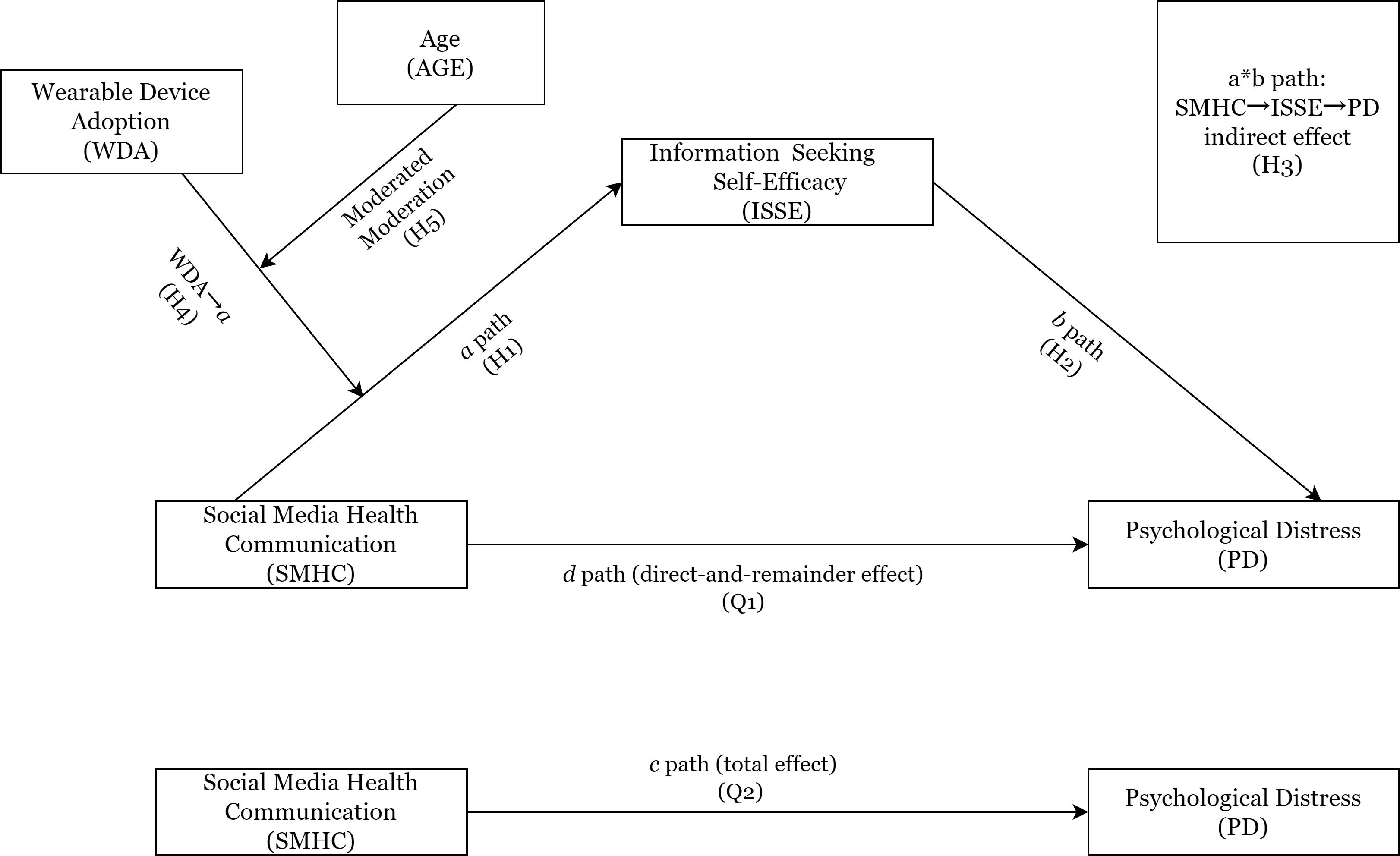
The proposed model contains several claims that require different evidence. The total communication–distress coefficient addresses whether respondents who communicated more frequently also reported more distress after adjustment for the selected covariates. The first-stage coefficient addresses whether communication frequency varied with confidence in finding helpful resources. The second-stage coefficient addresses whether confidence retained an association with distress at a common level of communication frequency. Their product summarizes an indirect statistical association. A moderation term addresses slope heterogeneity, and a three-way term asks whether that heterogeneity itself changes across age. Each coefficient therefore answers a narrower question than the verbal model taken as a whole.
This estimand-first separation prevents a common inferential shortcut. A precisely estimated communication–confidence path and a precisely estimated three-way interaction can coexist with an indirect product centered near zero whenever confidence has little independent association with distress. Likewise, a wearable difference in the confidence slope can appear even when adopters and nonadopters have positive slopes. The hypothesized process is supported only to the extent that the corresponding coefficient or bootstrap product answers that exact claim. Conditional-process analysis is therefore used here as a disciplined decomposition of covariance rather than an automatic mechanism detector.
Covariate adjustment narrows the comparison but retains the observational assignment process. Age, income, education, and social position can shape device adoption, communication behavior, confidence, and distress through pathways that the available variables only partly represent. Health status, health anxiety, Internet access quality, and the credibility of encountered content are especially plausible omitted determinants. The resulting estimand is an adjusted respondent-level association under the specified linear model. This explicit scope permits the results to inform later longitudinal and experimental work while reserving temporal interpretation for designs built to identify it.
2.3 Social Media Health Communication and Psychological Distress
Social media health communication can offer informational and relational resources. Users may learn the language needed to ask clinicians questions, discover patient communities, or recognize that others share their experiences (Chou et al., 2021; Jacobs et al., 2017; Takahashi et al., 2009). Yet health communication can also increase the salience of illness, expose users to alarming anecdotes, and create conflicts among recommendations. These burdens are especially plausible when content volume exceeds users’ capacity to select and integrate it (Whelan et al., 2020; Xie et al., 2023).
The HINTS measure used here captures active forms of communication—sharing personal information, interacting with people who have similar health problems, and watching health-related videos—rather than elapsed screen time. More frequent engagement can therefore indicate greater exposure to both support and illness-related concern (Choudhury & Asan, 2021; Mougharbel et al., 2023). People who are already distressed may also seek or share more health information. Even with that ambiguity, a positive adjusted association is a reasonable expectation.
Hypothesis 1. More frequent social media health communication is positively associated with psychological distress.
2.4 Information-Seeking Self-Efficacy as a Statistical Intermediary
Self-efficacy provides a plausible cognitive connection between communication behavior and distress, but the direction of the first-stage association is not self-evident. Successful searches and repeated interaction can supply mastery experiences that strengthen confidence. At the same time, contradictory or excessive information can generate confusion and reveal uncertainty, potentially eroding confidence (Li et al., 2024; Matthes et al., 2024). Evidence that online self-efficacy predicts information seeking also leaves open reciprocal selection: confident users may simply engage more often (Cao et al., 2016; Rains, 2008).
The second-stage expectation is clearer. Confidence in locating useful resources may reduce helplessness and make health uncertainty more manageable. Caregiver research, for example, links communication-related efficacy with lower psychological strain (Oh, 2017). Nevertheless, a one-item confidence rating may have limited independent association with a broad distress scale once demographic differences and communication frequency are held constant. Because the competing first-stage processes lead to different signs, the test focuses on whether the bootstrap interval for the product term excludes zero rather than presuming a causal sequence.
Hypothesis 2. Information-seeking self-efficacy statistically mediates the association between social media health communication and psychological distress.
2.5 Wearable Adoption as a First-Stage Moderator
Wearables provide continuous and personalized information that differs from the socially produced content encountered online. Device feedback can support self-monitoring, goal setting, and perceived control (Gao et al., 2015; Rieder et al., 2021). Wearable users also tend to report greater confidence in managing health, although selection into adoption remains a competing explanation (Xie et al., 2021). These observations imply that adoption may alter, rather than simply add to, the association between social media activity and search confidence.
Two mechanisms predict opposite directions. A complementarity account suggests that personal metrics help users interpret social media content, making communication more strongly associated with search confidence. A redundancy account suggests that adopters already possess an alternative information and feedback channel, reducing the marginal association between additional social media communication and confidence. Existing evidence that device effects depend on context and sustained engagement does not resolve this contest (de Vries et al., 2025; Patel et al., 2015). The moderation hypothesis therefore concerns whether the slope differs, with its direction determined empirically.
Hypothesis 3. Wearable-device adoption moderates the association between social media health communication and information-seeking self-efficacy.
2.6 Age as a Boundary Condition
Age may condition the role of wearables because it combines cohort differences in digital experience with differences in health need and technology use. Older adults are, on average, less likely to adopt new digital health tools and may encounter more usability barriers (Barnard et al., 2013; Chandrasekaran et al., 2021). Digital inequality also persists within older populations: access, skills, and uses vary substantially by education and other resources (Friemel, 2016; Hargittai & Dobransky, 2017). These patterns caution against treating age as a proxy for inability.
Age can make either complementarity or redundancy more pronounced. For an older adopter who integrates device data successfully, personalized feedback may make social media content easier to interpret. Alternatively, because the wearable already supplies salient personal information, additional social media activity may contribute relatively little to confidence. Reviews show that older users can benefit from wearables while still facing adoption and sustained-use barriers (Fowe & Boot, 2022; Moore et al., 2021). We therefore test whether age changes the wearable-by-communication interaction without assuming that adoption confers a uniform advantage.
Hypothesis 4. Age moderates the moderating association of wearable adoption with the social media health communication–information-seeking self-efficacy relationship.
3. Method
3.1 Data Source and Analytic Sample
We used the public-use HINTS 6 data file. HINTS is a cross-sectional survey of U.S. adults designed by the National Cancer Institute to study cancer- and health-information knowledge, attitudes, and behaviors (National Cancer Institute, 2022). The public file contained 6,252 respondents. Although the survey used a complex national design, the archived analysis for this manuscript applied unweighted ordinary least squares models. We retain that estimand and describe the results as associations in the analytic respondent sample, not as population-weighted U.S. estimates.
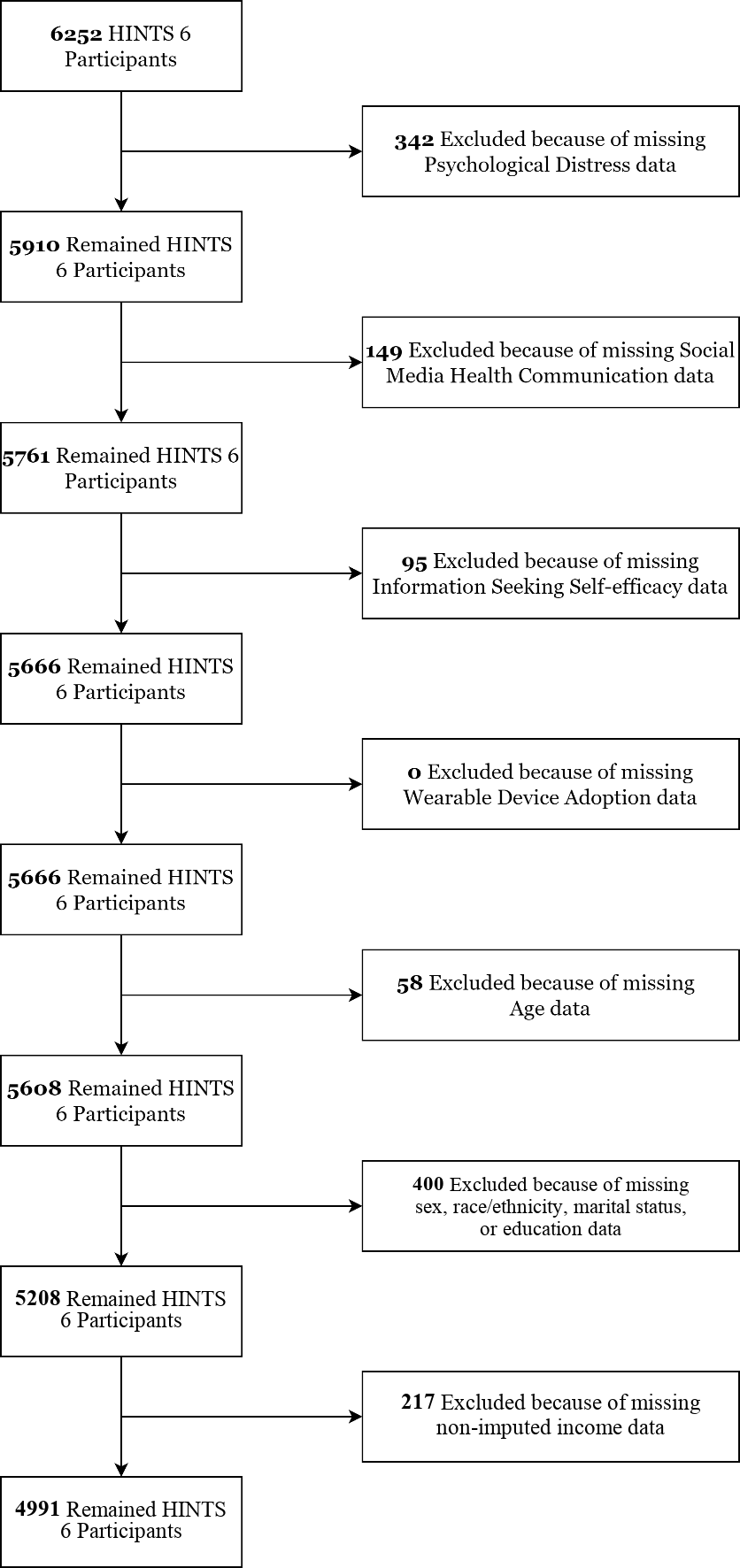
The complete-case sample was reconstructed directly from the public variables and the official HINTS 6 instrument. Valid scores were available for psychological distress for 5,910 respondents; 149 additional records lacked one or more of the three social media communication items, 95 lacked the self-efficacy item, and 58 lacked age. Wearable adoption was complete among the remaining cases. Complete sex-assigned-at-birth, race/ethnicity, marital status, and education data left 5,208 records, and excluding 217 records without non-imputed income produced the final sample of 4,991. Supplementary Table S2 records each step so that the sample can be reconstructed independently.
3.2 Measures
3.2.1 Social Media Health Communication
Social media health communication was the sum of three HINTS 6 frequency items asking how often, in the past 12 months, respondents had shared personal health information on social media; interacted with people who had similar health or medical issues on social media or online forums; and watched a health-related video on a social media site such as YouTube. Responses were coded 0 (never), 1 (less than once a month), 2 (a few times a month), 3 (at least once a week), and 4 (almost every day), then summed (0–12). Higher scores indicate more frequent active communication. Internal consistency was modest (Cronbach’s α = .637), so the score should be interpreted as a compact behavioral-frequency index rather than a unidimensional clinical scale.
3.2.2 Information-Seeking Self-Efficacy
Information-seeking self-efficacy was measured with one item: “How confident are you that you can find helpful health resources on the Internet?” Responses were coded from 0 (not confident at all) to 4 (completely confident). The item captures confidence in locating helpful resources, not demonstrated search performance or the ability to judge accuracy. Single-item efficacy measures can be predictive in narrowly specified domains, but they do not permit an internal-consistency estimate and may omit facets of the construct (Hoeppner et al., 2011).
3.2.3 Psychological Distress
Psychological distress was measured with the four-item Patient Health Questionnaire (PHQ-4). Respondents reported how often during the prior two weeks they experienced little interest or pleasure, felt down or hopeless, felt nervous or on edge, and could not stop or control worrying. Each item ranged from 0 (not at all) to 3 (nearly every day), yielding a 0–12 sum in which higher scores indicate more frequent anxiety and depressive symptoms (Kroenke et al., 2009). Internal consistency in the analytic sample was α = .863.
3.2.4 Wearable Adoption, Age, and Covariates
Wearable adoption indicated a yes response to whether the respondent had used an electronic wearable device such as a Fitbit, Apple Watch, or Garmin Vivofit to monitor or track health or activity in the prior 12 months (1 = adopter, 0 = nonadopter). Age was reported in years (18–99). Covariates were sex assigned at birth (male versus female), race/ethnicity (non-Hispanic White, non-Hispanic Black, Hispanic, non-Hispanic Asian, and other, with other as the reference), marital status (married, living with a romantic partner, divorced, widowed, separated, and single, with single as the reference), education (seven ordered categories), and annual household income (five ordered categories). The analysis used the non-imputed income field to preserve the archived model’s complete-case definition.
3.3 Analytic Strategy
We first summarized the analytic sample and estimated Pearson correlations. Hypothesis 1 was tested with an adjusted ordinary least squares regression of distress on social media health communication. The mediation analysis then estimated the communication–self-efficacy path and an outcome model containing both communication and self-efficacy. The indirect association was evaluated with 5,000 percentile bootstrap draws. Consistent with the limits of cross-sectional mediation applications (Li et al., 2026), the product term is described as a statistical indirect association and not as evidence of temporal transmission.
Hypothesis 3 was tested by adding the communication-by-wearable interaction to the self-efficacy model. Hypothesis 4 was tested with all lower-order terms and the communication-by-wearable-by-age interaction. The outcome equation was the same as in the mediation model. These equations correspond to PROCESS Models 4, 1, and 11 (Hayes, 2022). Conditional interaction tests and simple slopes were evaluated at ages 35, 57, and 72, the representative values retained in the archived output. All models included the same covariates.
To make coefficients comparable across differently bounded variables, we also report the percentage coefficient, bₚ, defined as b multiplied by the conceptual range of the predictor divided by the conceptual range of the outcome (Zhao et al., 2024). The transformation uses the prespecified ranges 0–12 for social media health communication and distress, 0–4 for self-efficacy, 0–1 for wearable adoption, and 18–99 for age. For interactions, component variables were mapped to 0–1 before products were formed. Thus, bₚ is a conceptual-range contrast, not a standardized beta and not a sample-range min–max coefficient. Two-sided 95% confidence intervals are reported. No adjustment for multiple testing was applied, and statistical significance is not treated as a substitute for effect magnitude or design credibility (Li et al., 2025).
Table 1: Characteristics of the Complete-Case Analytic Sample (N = 4,991)
| Characteristic | n | % or M (SD) |
|---|---|---|
| Age, M (SD), years | 4,991 | 54.65 (17.11) |
| Sex assigned at birth | ||
| Female | 2,976 | 59.6 |
| Male | 2,015 | 40.4 |
| Race/ethnicity | ||
| Non-Hispanic White | 2,887 | 57.8 |
| Non-Hispanic Black | 788 | 15.8 |
| Hispanic | 882 | 17.7 |
| Non-Hispanic Asian | 261 | 5.2 |
| Non-Hispanic other | 173 | 3.5 |
| Marital status | ||
| Married | 2,313 | 46.3 |
| Living with a romantic partner | 349 | 7.0 |
| Divorced | 770 | 15.4 |
| Widowed | 460 | 9.2 |
| Separated | 118 | 2.4 |
| Single, never married | 981 | 19.7 |
| Education | ||
| Less than 8 years | 74 | 1.5 |
| 8 through 11 years | 201 | 4.0 |
| High school | 839 | 16.8 |
| Post-high-school vocational/technical | 363 | 7.3 |
| Some college | 1,063 | 21.3 |
| College graduate | 1,437 | 28.8 |
| Postgraduate | 1,014 | 20.3 |
| Annual household income | ||
| Less than $20,000 | 772 | 15.5 |
| $20,000–$34,999 | 641 | 12.8 |
| $35,000–$49,999 | 646 | 12.9 |
| $50,000–$74,999 | 872 | 17.5 |
| $75,000 or more | 2,060 | 41.3 |
| Wearable adopter | 1,756 | 35.2 |
Note. Percentages may differ from 100 because of rounding. The table describes the unweighted complete-case sample. Income uses the non-imputed public-use field and was grouped from nine categories into five.
Table 2: Descriptive Statistics and Pearson Correlations Among Focal Variables
| Variable | M | SD | Range | α | 1 | 2 | 3 | 4 | 5 |
|---|---|---|---|---|---|---|---|---|---|
| 1. Psychological distress | 2.23 | 2.80 | 0–12 | .863 | — | ||||
| 2. Social media health communication | 1.59 | 1.95 | 0–12 | .637 | .178 | — | |||
| 3. Information-seeking self-efficacy | 2.41 | 0.98 | 0–4 | — | −.007 | .212 | — | ||
| 4. Wearable adoption | 0.35 | 0.48 | 0–1 | — | .003 | .166 | .172 | — | |
| 5. Age | 54.65 | 17.11 | 18–99 | — | −.218 | −.292 | −.264 | −.237 | — |
Note. N = 4,991. Wearable adoption is coded 0 = nonadopter and 1 = adopter. Alpha is not applicable to the single-item and demographic variables. Correlations are unweighted.
4. Results
4.1 Sample Characteristics
The 4,991 respondents had a mean age of 54.65 years (SD = 17.11); 59.6% were women and 35.2% had used a wearable device in the prior year. The mean social media health communication score was 1.59 (SD = 1.95), the mean information-seeking self-efficacy score was 2.41 (SD = 0.98), and the mean distress score was 2.23 (SD = 2.80). The communication score correlated positively with distress (r = .178), self-efficacy (r = .212), and wearable adoption (r = .166), and negatively with age (r = −.292). Self-efficacy had almost no bivariate association with distress (r = −.007).
These descriptive relations already qualify the proposed mechanism. Communication frequency was associated with both greater distress and greater search confidence, while confidence itself was not materially related to distress. A detectable communication–confidence coefficient therefore would not, by itself, demonstrate an indirect association with distress.
4.2 Association With Distress and Mediation Test
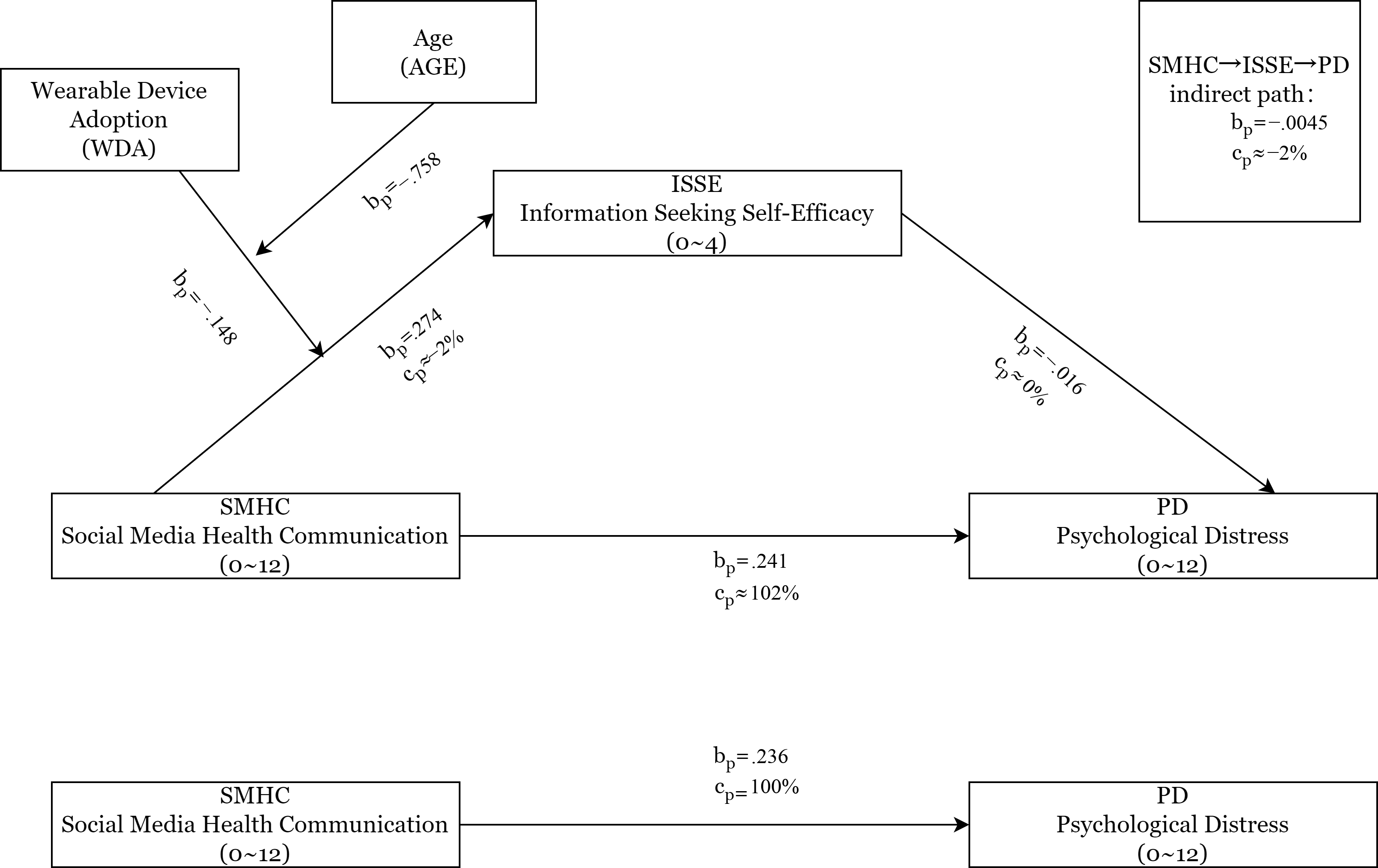
Controlling for demographics, social media health communication was positively associated with psychological distress, bₚ = .236, SE = .020, 95% CI [.197, .275], p < .001; the model explained 8.1% of the variance. Hypothesis 1 was supported as an adjusted cross-sectional association. A full conceptual-range increase in communication corresponded to approximately 23.6% of the conceptual distress range, conditional on the included covariates. Following Zhao et al. (2024), this coefficient describes a scale-relative conditional contrast, an estimand distinct from a within-person causal change.
Communication was positively associated with self-efficacy, bₚ = .274, SE = .020, 95% CI [.234, .314], p < .001. When communication and self-efficacy were entered together in the distress model, the direct communication coefficient remained positive, bₚ = .241, SE = .020, 95% CI [.201, .281], p < .001, whereas the self-efficacy coefficient was small and not statistically distinguishable from zero, bₚ = −.016, SE = .014, 95% CI [−.044, .011], p = .239. The bootstrap indirect association was bₚ = −.0045, bootstrap SE = .0040, 95% bootstrap CI [−.0125, .0031]. Because the interval included zero, Hypothesis 2 was not supported.
Mediation requires evidence from both component paths and the bootstrap product. Here, communication was associated with confidence, whereas the adjusted confidence–distress coefficient and the product interval were centered close to zero. Interpreting only the small p value for the first stage would substitute a significance narrative for the product-of-coefficients evidence (Li et al., 2025).
Table 3: Focal Regression, Mediation, and Moderation Results
| Model term | bₚ | SE | 95% CI | p | R² | ΔR² | Decision |
|---|---|---|---|---|---|---|---|
| Total association: SMHC → PD | .236 | .020 | [.197, .275] | < .001 | .0809 | — | H1 supported |
| First stage: SMHC → ISSE | .274 | .020 | [.234, .314] | < .001 | .1193 | — | — |
| Direct-and-remainder: SMHC → PD | .241 | .020 | [.201, .281] | < .001 | .0812 | — | — |
| Second stage: ISSE → PD | −.016 | .014 | [−.044, .011] | .239 | .0812 | — | — |
| Indirect: SMHC → ISSE → PD | −.0045 | .0040† | [−.0125, .0031]† | — | — | — | H2 not supported |
| SMHC × wearable adoption → ISSE | −.148 | .041 | [−.228, −.068] | < .001 | .1269 | .0023 | H3 supported |
| SMHC × wearable adoption × age → ISSE | −.758 | .195 | [−1.140, −.377] | < .001 | .1553 | .0026 | H4 supported |
| Index of moderated moderated mediation | .0124 | .0117† | [−.0087, .0377]† | — | — | — | Not supported |
Note. N = 4,991. bₚ is the conceptual-range percentage coefficient, not a standardized beta. All models are unweighted and adjust for sex assigned at birth, race/ethnicity, marital status, education, and income. †Bootstrap SE and percentile bootstrap CI based on 5,000 draws. R² belongs to the full equation shown; ΔR² is the increment for the highest-order interaction.
4.3 Conditional Association With Information-Seeking Self-Efficacy
In the first-stage moderation model, the communication-by-wearable interaction was negative, bₚ = −.148, SE = .041, 95% CI [−.228, −.068], p < .001, ΔR² = .0023. The positive communication–self-efficacy association was therefore weaker among wearable adopters than among nonadopters. Hypothesis 3 was supported. The interaction was small in incremental variance terms and should not be recast as proof that wearables protect users from distress; its outcome was search confidence, not distress.
The three-way communication-by-wearable-by-age interaction was also negative, bₚ = −.758, SE = .195, 95% CI [−1.140, −.377], p < .001, ΔR² = .0026. The wearable difference in the communication slope was not detectable at age 35, bₚ = .055, p = .296, but it was negative at age 57, bₚ = −.151, p = .001, and age 72, bₚ = −.291, p < .001. Thus, the dampening associated with wearable adoption became more pronounced at older ages, supporting Hypothesis 4.
Simple slopes clarify the interaction. At age 35, communication was positively associated with self-efficacy for both nonadopters (b = .0315, 95% CI [.0066, .0564]) and adopters (b = .0498, 95% CI [.0259, .0737]). At age 57, the association was larger for nonadopters (b = .1014, 95% CI [.0826, .1202]) than adopters (b = .0512, 95% CI [.0267, .0757]). At age 72, it was again larger for nonadopters (b = .1491, 95% CI [.1217, .1765]) than adopters (b = .0520, 95% CI [.0144, .0897]). Table 4 reports the corresponding conditional estimates at the three representative ages.
The conditional first-stage pattern did not produce supported moderated mediation. Every conditional indirect-effect interval included zero, and the index of moderated moderated mediation was .0124, bootstrap SE = .0117, 95% bootstrap CI [−.0087, .0377]. The supported conclusion is therefore asymmetric: age and wearable adoption conditioned how communication related to search confidence, while the bootstrap evidence for transmission to distress through confidence remained centered around zero.
Table 4: Conditional First-Stage and Indirect Associations
| Effect | Wearable status | Age | Estimate | SE | 95% CI | p |
|---|---|---|---|---|---|---|
| Panel A. Conditional SMHC × wearable interaction | ||||||
| Interaction | — | 35 | .055 | .053 | [−.048, .158] | .296 |
| Interaction | — | 57 | −.151 | .047 | [−.243, −.058] | .001 |
| Interaction | — | 72 | −.291 | .071 | [−.430, −.152] | < .001 |
| Panel B. Conditional SMHC simple slopes on ISSE | ||||||
| Simple slope | Nonadopter | 35 | .0315 | .0127 | [.0066, .0564] | .013 |
| Simple slope | Adopter | 35 | .0498 | .0122 | [.0259, .0737] | < .001 |
| Simple slope | Nonadopter | 57 | .1014 | .0096 | [.0826, .1202] | < .001 |
| Simple slope | Adopter | 57 | .0512 | .0125 | [.0267, .0757] | < .001 |
| Simple slope | Nonadopter | 72 | .1491 | .0140 | [.1217, .1765] | < .001 |
| Simple slope | Adopter | 72 | .0520 | .0192 | [.0144, .0897] | .007 |
| Panel C. Conditional indirect associations | ||||||
| Indirect | Nonadopter | 35 | −.0015 | .0016† | [−.0053, .0011]† | — |
| Indirect | Nonadopter | 57 | −.0050 | .0045† | [−.0139, .0034]† | — |
| Indirect | Nonadopter | 72 | −.0073 | .0066† | [−.0206, .0051]† | — |
| Indirect | Adopter | 35 | −.0024 | .0023† | [−.0073, .0017]† | — |
| Indirect | Adopter | 57 | −.0025 | .0023† | [−.0075, .0018]† | — |
| Indirect | Adopter | 72 | −.0026 | .0026† | [−.0085, .0018]† | — |
Note. Panel A estimates are conceptual-range interaction coefficients; Panel B estimates are natural-scale slopes for a one-point increase in the 0–12 communication score; Panel C estimates are bₚ indirect associations. †Bootstrap SE and percentile bootstrap CI based on 5,000 draws. All conditional indirect intervals include zero.
5. Discussion
5.1 What the Findings Establish
The analysis yields three distinct findings. First, more frequent active health communication on social media was associated with greater psychological distress after adjustment for measured demographics. Second, more frequent communication was also associated with greater confidence in finding helpful online health resources, but that confidence was not independently associated with distress and did not carry a supported indirect association. Third, wearable adoption and age jointly changed the first-stage communication–confidence association, while the moderated mediation index remained uncertain. Keeping these findings separate is the principal interpretive requirement.
The positive communication–distress association is consistent with the idea that health-related social media activity can concentrate attention on illness, uncertainty, and emotionally salient experiences. It is also consistent with reverse selection: people experiencing anxiety or depressive symptoms may search, share, or connect more often. The present data cannot distinguish these explanations. Nor does the three-item communication index identify whether respondents encountered accurate, misleading, reassuring, or frightening content. The finding therefore concerns behavioral frequency and distress, not the effect of a particular content environment.
The failed mediation hypothesis is theoretically informative. Search confidence was positively related to communication frequency, which fits a practice or selective-participation account, yet confidence did not explain variation in distress once communication and covariates were included. A narrow belief about finding helpful resources may be insufficient to offset emotional reactions to health information. Confidence can also be inaccurate: feeling able to find information does not ensure that the information is reliable or that it reduces uncertainty. This distinction reinforces the need to measure appraisal skill, source quality, and emotional response separately rather than treating them as interchangeable dimensions of digital health literacy.
Taken together, the coefficient profile locates the empirical boundary of the proposed mechanism. The stable feature is the adjusted communication–distress association, which changes little when search confidence enters the outcome equation. The conditional feature lies in the communication–confidence slope, which varies by wearable status and age. The near-zero confidence–distress coefficient leaves these two features statistically disconnected in the present sample. This distinction directs substantive attention toward emotional reactions, content characteristics, health anxiety, and other pathways that could link communication behavior with distress. It also suggests that increasing search confidence alone may be a weak intervention target unless confidence is paired with accurate appraisal, credible sources, and support for managing threatening information.
5.2 Interpreting Wearable Adoption and Age
Wearable adoption weakened the positive association between social media health communication and search confidence, especially at older ages. Wearable devices operate within broader self-regulatory practices rather than as stand-alone drivers (Patel et al., 2015; Rieder et al., 2021). All six reported simple communication slopes were positive, so the empirical difference concerns the marginal slope. One post hoc explanation is informational redundancy. Adopters already receive individualized metrics and repeated feedback, so additional social media communication may contribute less to their confidence than it does for nonadopters. The mechanism remains a post hoc account whose direct test requires measures of how users integrate device feedback with social media information.
The age pattern requires equally careful language. At older ages, adopters showed smaller communication slopes rather than a larger modeled wearable advantage. At ages 57 and 72, communication slopes were substantially larger among nonadopters, whereas adopter slopes remained positive and comparatively stable. This could reflect redundancy among adopters, stronger self-selection among older users, different health needs, or unmeasured disparities in digital skills. Age-based digital inequality research emphasizes that chronological age does not uniquely determine technology capability (Friemel, 2016; Hargittai & Dobransky, 2017; Huang & Ye, 2025). Any intervention derived from these results should therefore assess skills and access directly rather than target people on age alone.
The very small increments in explained variance are also consequential. The interaction terms were estimated precisely in a sample of nearly 5,000 respondents, but ΔR² values were .0023 and .0026. As Li et al. (2025) argued more generally, statistical detectability should not be allowed to inflate a theoretical narrative. The effects identify a focused conditional pattern whose explanatory reach is modest and whose stability requires replication.
5.3 Alternative Explanations and Discriminating Evidence
Several data-generating processes could produce the observed first-stage interaction. Selection into wearable adoption is one. Adopters may begin with greater digital confidence, more resources, stronger interest in health tracking, or a more proactive orientation. At older ages, the selectivity of adoption may be especially strong because device uptake is less common and may require more support. In that case, adopters would enter the survey with a relatively stable level of search confidence, leaving less cross-sectional covariance for communication frequency to explain. A prospective adoption study with pre-adoption confidence measures could distinguish this selection account from a change attributable to device use.
Information-channel substitution offers a second explanation. Nonadopters may rely more heavily on social media interaction and videos as opportunities to practice searching and to locate peer knowledge. Adopters may distribute the same informational work across device dashboards, apps, clinicians, and social media. The smaller adopter slope would then reflect a diversified information ecology rather than a loss of efficacy. Testing this account requires channel-specific measures: frequency of consulting wearable data, use of linked health apps, discussion of device metrics with clinicians, and the extent to which social media searches are prompted by device readings.
Measurement heterogeneity provides a third explanation. Sharing personal information, peer interaction, and video viewing may have different associations with confidence across age and adoption groups, yet the summed index imposes one common slope. The modest alpha suggests that these behaviors should also be analyzed separately in a replication. Similarly, confidence in finding helpful resources may function differently for experienced and inexperienced users. Multi-item measures of search planning, source evaluation, and confidence calibration would permit measurement invariance tests and would clarify whether the interaction concerns differences in perceived capability or different interpretations of a single survey item.
5.4 Implications
For health communicators, the results favor a diagnostic rather than a universal intervention. High-frequency users may need help judging source quality and managing emotionally difficult content, even when they feel confident in locating information. Confidence checks alone may therefore miss users who are both active and distressed. Platforms and public health organizations could pair search guidance with transparent source cues, uncertainty statements, and routes to professional support.
For wearable programs, the findings argue against presenting device adoption as a generic buffer. Wearable data could complement online content, substitute for it, or simply mark users who differ before adoption. Interventions should test whether integrating social media claims with personal device data improves calibrated understanding, not merely confidence. Age-inclusive design should address readability, onboarding, data interpretation, privacy, and sustained support while allowing for wide variation within age groups (Moore et al., 2021).
5.5 Limitations and Future Research
Several limitations bound the claims. First, all focal variables were observed at one time point. Reverse causation and unmeasured confounding are plausible, so the terms direct, indirect, and moderation refer to regression structure rather than causal processes. Longitudinal designs can test temporal ordering more credibly; cross-lagged network work illustrates one way to separate prospective relations from same-wave covariation (Ju et al., 2026). Experiments that manipulate information volume, source cues, or wearable feedback would provide a stronger test of the proposed redundancy and complementarity accounts.
Second, measurement is limited. The communication index contained three heterogeneous behaviors and had modest reliability (α = .637). The single self-efficacy item captured perceived ability to find helpful resources but not evaluation skill, calibration, or actual search performance. Wearable adoption was binary and did not distinguish device type, duration, adherence, or whether respondents used the data when evaluating social media content. Future studies should combine validated multi-item measures with behavioral logs and content-level indicators.
Third, the analysis used complete cases and the non-imputed income field. Missingness may be systematic, and the retained respondents need not represent those excluded. Fourth, the OLS models did not use HINTS survey weights or design variables. The coefficients therefore describe this analytic sample and should not be presented as nationally representative prevalence or population effects. A prespecified replication should compare weighted design-based estimates, multiple-imputation results, and the archived complete-case models.
Fifth, explanation and prediction were not separated. Out-of-sample validation could show whether communication, wearable use, and age meaningfully improve prediction beyond demographics without treating predictive accuracy as causal evidence. Methodological work by Liu and Li (2024) emphasizes that responsible social-science use of machine learning depends on the inferential purpose and validation design rather than blanket acceptance or rejection. Such analyses could complement, but not replace, theory-guided tests of mechanism.
6. Conclusion
Among 4,991 HINTS 6 respondents, more frequent social media health communication was associated with greater psychological distress and greater confidence in finding online health resources. Confidence did not independently predict distress in the fitted model, leaving both the indirect association and the moderated moderated mediation index unsupported. Wearable adoption and age nevertheless conditioned the communication–confidence association: the adopter–nonadopter difference became more negative at older ages. The contribution is a precise map of the observed conditional variation and the near-zero indirect pathway, providing a bounded target for longitudinal and experimental replication.
Competing Interests
The authors declare that they have no competing interests.
Data Availability
The HINTS 6 public-use dataset and survey documentation are available from the National Cancer Institute at https://hints.cancer.gov/data/download-data.aspx.
Ethical Approval
HINTS 6 was designated exempt research under 45 CFR 46.104 and approved by the Westat Institutional Review Board on May 10, 2021 (Project #6632.03.51); an amendment was approved on November 24, 2021 (Amendment ID #3597). The NIH Office of IRB Operations determined HINTS 6 to be not human subjects research on August 16, 2021 (iRIS reference number 562715). The present study used the publicly available, de-identified data and involved no new recruitment or participant contact.
Informed Consent
The present secondary analysis did not recruit participants or obtain new consent. Participation and consent procedures were administered as part of the original HINTS 6 data collection by the National Cancer Institute and its survey contractor.
Author Contributions
Dehou You: Conceptualization, Methodology, Writing – original draft, Writing – review & editing. Chengyu Xu: Methodology, Validation, Writing – original draft, Writing – review & editing. Hongyan Lai: Validation, Writing – review & editing. Mengxin Ding: Validation, Writing – review & editing. Xiaoran Zhang: Conceptualization, Supervision, Writing – review & editing, Project administration. Dianshi Moses Li: Conceptualization, Methodology, Supervision, Writing – review & editing, Project administration. All authors read and approved the final manuscript.
Fund Program
This research received no specific grant from any funding agency in the public, commercial, or not-for-profit sectors.
References
- [1]
Anwar, A., Malik, M., Raees, V., & Anwar, A. (2020). Role of mass media and public health communications in the COVID-19 pandemic. Cureus, 12(9), e10453. https://doi.org/10.7759/cureus.10453
- [2]
Apuke, O. D., & Omar, B. (2021). Fake news and COVID-19: Modelling the predictors of fake news sharing among social media users. Telematics and Informatics, 56, 101475. https://doi.org/10.1016/j.tele.2020.101475
- [3]
Bandura, A. (1977). Self-efficacy: Toward a unifying theory of behavioral change. Psychological Review, 84(2), 191–215. https://doi.org/10.1037/0033-295X.84.2.191
- [4]
Bandura, A. (1989). Human agency in social cognitive theory. American Psychologist, 44(9), 1175–1184. https://doi.org/10.1037/0003-066X.44.9.1175
- [5]
Barnard, Y., Bradley, M. D., Hodgson, F., & Lloyd, A. D. (2013). Learning to use new technologies by older adults: Perceived difficulties, experimentation behaviour and usability. Computers in Human Behavior, 29(4), 1715–1724. https://doi.org/10.1016/j.chb.2013.02.006
- [6]
Cao, W., Zhang, X., Xu, K., & Wang, Y. (2016). Modeling online health information-seeking behavior in China: The roles of source characteristics, reward assessment, and Internet self-efficacy. Health Communication, 31(9), 1105–1114. https://doi.org/10.1080/10410236.2015.1045236
- [7]
Chandrasekaran, R., Katthula, V., & Moustakas, E. (2021). Too old for technology? Use of wearable healthcare devices by older adults and their willingness to share health data with providers. Health Informatics Journal, 27(4), 14604582211058073. https://doi.org/10.1177/14604582211058073
- [8]
Chen, J., & Wang, Y. (2021). Social media use for health purposes: Systematic review. Journal of Medical Internet Research, 23(5), e17917. https://doi.org/10.2196/17917
- [9]
Chou, H.-T. G., & Edge, N. (2012). “They are happier and having better lives than I am”: The impact of using Facebook on perceptions of others’ lives. Cyberpsychology, Behavior, and Social Networking, 15(2), 117–121. https://doi.org/10.1089/cyber.2011.0324
- [10]
Chou, W.-Y. S., Gaysynsky, A., Trivedi, N., & Vanderpool, R. C. (2021). Using social media for health: National data from HINTS 2019. Journal of Health Communication, 26(3), 184–193. https://doi.org/10.1080/10810730.2021.1903627
- [11]
Choudhury, A., & Asan, O. (2021). Impact of using wearable devices on psychological distress: Analysis of the Health Information National Trends Survey. International Journal of Medical Informatics, 156, 104612. https://doi.org/10.1016/j.ijmedinf.2021.104612
- [12]
de Vries, H. J., Delahaij, R., van Zwieten, M., Verhoef, H., & Kamphuis, W. (2025). The effects of self-monitoring using a smartwatch and smartphone app on stress awareness, self-efficacy, and well-being-related outcomes in police officers: Longitudinal mixed design study. JMIR mHealth and uHealth, 13, e60708. https://doi.org/10.2196/60708
- [13]
Eastin, M. S., & LaRose, R. (2000). Internet self-efficacy and the psychology of the digital divide. Journal of Computer-Mediated Communication, 6(1), JCMC611. https://doi.org/10.1111/j.1083-6101.2000.tb00110.x
- [14]
Fowe, I. E., & Boot, W. R. (2022). Understanding older adults’ attitudes toward mobile and wearable technologies to support health and cognition. Frontiers in Psychology, 13, 1036092. https://doi.org/10.3389/fpsyg.2022.1036092
- [15]
Friemel, T. N. (2016). The digital divide has grown old: Determinants of a digital divide among seniors. New Media & Society, 18(2), 313–331. https://doi.org/10.1177/1461444814538648
- [16]
Gao, Y., Li, H., & Luo, Y. (2015). An empirical study of wearable technology acceptance in healthcare. Industrial Management & Data Systems, 115(9), 1704–1723. https://doi.org/10.1108/IMDS-03-2015-0087
- [17]
Han, M., Tan, X. Y., Lee, R., Lee, J. K., & Mahendran, R. (2021). Impact of social media on health-related outcomes among older adults in Singapore: Qualitative study. JMIR Aging, 4(1), e23826. https://doi.org/10.2196/23826
- [18]
Hargittai, E., & Dobransky, K. (2017). Old dogs, new clicks: Digital inequality in skills and uses among older adults. Canadian Journal of Communication, 42(2), 195–212. https://doi.org/10.22230/cjc.2017v42n2a3176
- [19]
Hayes, A. F. (2022). Introduction to mediation, moderation, and conditional process analysis: A regression-based approach (3rd ed.). Guilford Press.
- [20]
Hoeppner, B. B., Kelly, J. F., Urbanoski, K. A., & Slaymaker, V. (2011). Comparative utility of a single-item versus multiple-item measure of self-efficacy in predicting relapse among young adults. Journal of Substance Abuse Treatment, 41(3), 305–312. https://doi.org/10.1016/j.jsat.2011.04.005
- [21]
Huang, M., & Ye, Y. (2025). “A matter of life and death”: Mitigating the gray digital divide in using health information technologies in the post-pandemic era. Health Communication, 40(4), 620–630. https://doi.org/10.1080/10410236.2024.2358279
- [22]
Jacobs, W., Amuta, A. O., & Jeon, K. C. (2017). Health information seeking in the digital age: An analysis of health information seeking behavior among US adults. Cogent Social Sciences, 3(1), 1302785. https://doi.org/10.1080/23311886.2017.1302785
- [23]
Ju, Q. R., Zhang, L., Zhao, X., & Li, D. M. (2026). Is marrying up better for mental health? Educational assortative mating, marital well-being, subjective socioeconomic status, and depressive symptoms among Chinese adults: Evidence from cross-lagged panel networks. Journal of Affective Disorders, 405, 121663. https://doi.org/10.1016/j.jad.2026.121663
- [24]
Kang, H. S., & Exworthy, M. (2022). Wearing the future—wearables to empower users to take greater responsibility for their health and care: Scoping review. JMIR mHealth and uHealth, 10(7), e35684. https://doi.org/10.2196/35684
- [25]
Kim, S., & Choudhury, A. (2020). Comparison of older and younger adults’ attitudes toward the adoption and use of activity trackers. JMIR mHealth and uHealth, 8(10), e18312. https://doi.org/10.2196/18312
- [26]
Kowalski, R. M., Giumetti, G. W., Schroeder, A. N., & Lattanner, M. R. (2014). Bullying in the digital age: A critical review and meta-analysis of cyberbullying research among youth. Psychological Bulletin, 140(4), 1073–1137. https://doi.org/10.1037/a0035618
- [27]
Kroenke, K., Spitzer, R. L., Williams, J. B. W., & Löwe, B. (2009). An ultra-brief screening scale for anxiety and depression: The PHQ-4. Psychosomatics, 50(6), 613–621. https://doi.org/10.1016/S0033-3182(09)70864-3
- [28]
Li, D. M., Zhang, H. L., & Ju, Q. R. (2025). Statistical significance, narrative, and the scholastic fallacy: How ritualized statistics exaggerate social science theories. Transformative Society, 1(2), 39–62. https://doi.org/10.63336/TransSoc.28
- [29]
Li, K., Jiang, S., Yan, X., & Li, J. (2024). Mechanism study of social media overload on health self-efficacy and anxiety. Heliyon, 10(1), e23326. https://doi.org/10.1016/j.heliyon.2023.e23326
- [30]
Li, M. M., Li, D. M., Ju, Q. R., Zhao, Y. J., Tuo, Z. T., Zhang, X. S., & Liu, J. (2026). Association between maternal age at childbirth and children’s internalising problems in the USA: A cross-sectional mediation analysis of housing instability and family support using the 2022 NSCH. BMJ Open, 16(2), e098280. https://doi.org/10.1136/bmjopen-2024-098280
- [31]
Liu, J., & Li, D. M. (2024). Is machine learning really unsafe and irresponsible in social sciences? Paradoxes and reconsideration from recidivism prediction tasks. Asian Journal of Criminology, 19(2), 143–159. https://doi.org/10.1007/s11417-024-09429-x
- [32]
Matthes, J., Karsay, K., Schmuck, D., & Stevic, A. (2020). “Too much to handle”: Impact of mobile social networking sites on information overload, depressive symptoms, and well-being. Computers in Human Behavior, 105, 106217. https://doi.org/10.1016/j.chb.2019.106217
- [33]
Matthes, J., Neureiter, A., Stevic, A., & Noetzel, S. (2024). “It’s too much”: Excessive smartphone use during the COVID-19 crisis, information overload, and infection self-efficacy. Telematics and Informatics, 89, 102119. https://doi.org/10.1016/j.tele.2024.102119
- [34]
Merlici, I.-A., Maftei, A., & Opariuc-Dan, C. (2024). This is too much! Social media integration and adults’ psychological distress: The mediating role of cyber and place-based information overload. Behaviour & Information Technology. Advance online publication. https://doi.org/10.1080/0144929X.2024.2406252
- [35]
Moore, K., O’Shea, E., Kenny, L., Barton, J., Tedesco, S., Sica, M., Crowe, C., Alamäki, A., Condell, J., & Nordström, A. (2021). Older adults’ experiences with using wearable devices: Qualitative systematic review and meta-synthesis. JMIR mHealth and uHealth, 9(6), e23832. https://doi.org/10.2196/23832
- [36]
Mougharbel, F., Chaput, J.-P., Sampasa-Kanyinga, H., Hamilton, H. A., Colman, I., Leatherdale, S. T., & Goldfield, G. S. (2023). Heavy social media use and psychological distress among adolescents: The moderating role of sex, age, and parental support. Frontiers in Public Health, 11, 1190390. https://doi.org/10.3389/fpubh.2023.1190390
- [37]
Naslund, J. A., Bondre, A., Torous, J., & Aschbrenner, K. A. (2020). Social media and mental health: Benefits, risks, and opportunities for research and practice. Journal of Technology in Behavioral Science, 5(3), 245–257. https://doi.org/10.1007/s41347-020-00134-x
- [38]
National Cancer Institute. (2022). Health Information National Trends Survey 6 (HINTS 6): Annotated English instrument. https://hints.cancer.gov/docs/Instruments/HINTS6_Annotated_English_Instrument.pdf
- [39]
Norman, C. D., & Skinner, H. A. (2006). eHealth literacy: Essential skills for consumer health in a networked world. Journal of Medical Internet Research, 8(2), e9. https://doi.org/10.2196/jmir.8.2.e9
- [40]
Oh, Y. S. (2017). Communications with health professionals and psychological distress in family caregivers to cancer patients: A model based on stress-coping theory. Applied Nursing Research, 33, 5–9. https://doi.org/10.1016/j.apnr.2016.09.008
- [41]
Patel, M. S., Asch, D. A., & Volpp, K. G. (2015). Wearable devices as facilitators, not drivers, of health behavior change. JAMA, 313(5), 459–460. https://doi.org/10.1001/jama.2014.14781
- [42]
Rains, S. A. (2008). Seeking health information in the information age: The role of Internet self-efficacy. Western Journal of Communication, 72(1), 1–18. https://doi.org/10.1080/10570310701827612
- [43]
Rieder, A., Eseryel, U. Y., Lehrer, C., & Jung, R. (2021). Why users comply with wearables: The role of contextual self-efficacy in behavioral change. International Journal of Human–Computer Interaction, 37(3), 281–294. https://doi.org/10.1080/10447318.2020.1819669
- [44]
Takahashi, Y., Uchida, C., Miyaki, K., Sakai, M., Shimbo, T., & Nakayama, T. (2009). Potential benefits and harms of a peer support social network service on the Internet for people with depressive tendencies: Qualitative content analysis and social network analysis. Journal of Medical Internet Research, 11(3), e29. https://doi.org/10.2196/jmir.1142
- [45]
Te Poel, F., Baumgartner, S. E., Hartmann, T., & Tanis, M. (2016). The curious case of cyberchondria: A longitudinal study on the reciprocal relationship between health anxiety and online health information seeking. Journal of Anxiety Disorders, 43, 32–40. https://doi.org/10.1016/j.janxdis.2016.07.009
- [46]
Whelan, E., Islam, A. N., & Brooks, S. (2020). Is boredom proneness related to social media overload and fatigue? A stress–strain–outcome approach. Internet Research, 30(3), 869–887. https://doi.org/10.1108/INTR-03-2019-0112
- [47]
Xie, T., Wang, Y., & Cheng, Y. (2023). Social media overload as a predictor of depressive symptoms under the COVID-19 infodemic: A cross-sectional survey from Chinese university students. International Journal of Public Health, 68, 1606404. https://doi.org/10.3389/ijph.2023.1606404
- [48]
Xie, Z., Yadav, S., & Jo, A. (2021). The association between electronic wearable devices and self-efficacy for managing health: A cross-sectional study using 2019 HINTS data. Health and Technology, 11(2), 331–339. https://doi.org/10.1007/s12553-021-00525-x
- [49]
Zhao, X., Li, D. M., Lai, Z. Z., Liu, P. L., Ao, S. H., & You, F. (2024). Percentage coefficient (bₚ)—Effect size analysis (Theory Paper 1). arXiv. https://doi.org/10.48550/arXiv.2404.19495
- [1]
Anwar, A., Malik, M., Raees, V., & Anwar, A. (2020). Role of mass media and public health communications in the COVID-19 pandemic. Cureus, 12(9), e10453. https://doi.org/10.7759/cureus.10453
- [2]
Apuke, O. D., & Omar, B. (2021). Fake news and COVID-19: Modelling the predictors of fake news sharing among social media users. Telematics and Informatics, 56, 101475. https://doi.org/10.1016/j.tele.2020.101475
- [3]
Bandura, A. (1977). Self-efficacy: Toward a unifying theory of behavioral change. Psychological Review, 84(2), 191–215. https://doi.org/10.1037/0033-295X.84.2.191
- [4]
Bandura, A. (1989). Human agency in social cognitive theory. American Psychologist, 44(9), 1175–1184. https://doi.org/10.1037/0003-066X.44.9.1175
- [5]
Barnard, Y., Bradley, M. D., Hodgson, F., & Lloyd, A. D. (2013). Learning to use new technologies by older adults: Perceived difficulties, experimentation behaviour and usability. Computers in Human Behavior, 29(4), 1715–1724. https://doi.org/10.1016/j.chb.2013.02.006
- [6]
Cao, W., Zhang, X., Xu, K., & Wang, Y. (2016). Modeling online health information-seeking behavior in China: The roles of source characteristics, reward assessment, and Internet self-efficacy. Health Communication, 31(9), 1105–1114. https://doi.org/10.1080/10410236.2015.1045236
- [7]
Chandrasekaran, R., Katthula, V., & Moustakas, E. (2021). Too old for technology? Use of wearable healthcare devices by older adults and their willingness to share health data with providers. Health Informatics Journal, 27(4), 14604582211058073. https://doi.org/10.1177/14604582211058073
- [8]
Chen, J., & Wang, Y. (2021). Social media use for health purposes: Systematic review. Journal of Medical Internet Research, 23(5), e17917. https://doi.org/10.2196/17917
- [9]
Chou, H.-T. G., & Edge, N. (2012). “They are happier and having better lives than I am”: The impact of using Facebook on perceptions of others’ lives. Cyberpsychology, Behavior, and Social Networking, 15(2), 117–121. https://doi.org/10.1089/cyber.2011.0324
- [10]
Chou, W.-Y. S., Gaysynsky, A., Trivedi, N., & Vanderpool, R. C. (2021). Using social media for health: National data from HINTS 2019. Journal of Health Communication, 26(3), 184–193. https://doi.org/10.1080/10810730.2021.1903627
- [11]
Choudhury, A., & Asan, O. (2021). Impact of using wearable devices on psychological distress: Analysis of the Health Information National Trends Survey. International Journal of Medical Informatics, 156, 104612. https://doi.org/10.1016/j.ijmedinf.2021.104612
- [12]
de Vries, H. J., Delahaij, R., van Zwieten, M., Verhoef, H., & Kamphuis, W. (2025). The effects of self-monitoring using a smartwatch and smartphone app on stress awareness, self-efficacy, and well-being-related outcomes in police officers: Longitudinal mixed design study. JMIR mHealth and uHealth, 13, e60708. https://doi.org/10.2196/60708
- [13]
Eastin, M. S., & LaRose, R. (2000). Internet self-efficacy and the psychology of the digital divide. Journal of Computer-Mediated Communication, 6(1), JCMC611. https://doi.org/10.1111/j.1083-6101.2000.tb00110.x
- [14]
Fowe, I. E., & Boot, W. R. (2022). Understanding older adults’ attitudes toward mobile and wearable technologies to support health and cognition. Frontiers in Psychology, 13, 1036092. https://doi.org/10.3389/fpsyg.2022.1036092
- [15]
Friemel, T. N. (2016). The digital divide has grown old: Determinants of a digital divide among seniors. New Media & Society, 18(2), 313–331. https://doi.org/10.1177/1461444814538648
- [16]
Gao, Y., Li, H., & Luo, Y. (2015). An empirical study of wearable technology acceptance in healthcare. Industrial Management & Data Systems, 115(9), 1704–1723. https://doi.org/10.1108/IMDS-03-2015-0087
- [17]
Han, M., Tan, X. Y., Lee, R., Lee, J. K., & Mahendran, R. (2021). Impact of social media on health-related outcomes among older adults in Singapore: Qualitative study. JMIR Aging, 4(1), e23826. https://doi.org/10.2196/23826
- [18]
Hargittai, E., & Dobransky, K. (2017). Old dogs, new clicks: Digital inequality in skills and uses among older adults. Canadian Journal of Communication, 42(2), 195–212. https://doi.org/10.22230/cjc.2017v42n2a3176
- [19]
Hayes, A. F. (2022). Introduction to mediation, moderation, and conditional process analysis: A regression-based approach (3rd ed.). Guilford Press.
- [20]
Hoeppner, B. B., Kelly, J. F., Urbanoski, K. A., & Slaymaker, V. (2011). Comparative utility of a single-item versus multiple-item measure of self-efficacy in predicting relapse among young adults. Journal of Substance Abuse Treatment, 41(3), 305–312. https://doi.org/10.1016/j.jsat.2011.04.005
- [21]
Huang, M., & Ye, Y. (2025). “A matter of life and death”: Mitigating the gray digital divide in using health information technologies in the post-pandemic era. Health Communication, 40(4), 620–630. https://doi.org/10.1080/10410236.2024.2358279
- [22]
Jacobs, W., Amuta, A. O., & Jeon, K. C. (2017). Health information seeking in the digital age: An analysis of health information seeking behavior among US adults. Cogent Social Sciences, 3(1), 1302785. https://doi.org/10.1080/23311886.2017.1302785
- [23]
Ju, Q. R., Zhang, L., Zhao, X., & Li, D. M. (2026). Is marrying up better for mental health? Educational assortative mating, marital well-being, subjective socioeconomic status, and depressive symptoms among Chinese adults: Evidence from cross-lagged panel networks. Journal of Affective Disorders, 405, 121663. https://doi.org/10.1016/j.jad.2026.121663
- [24]
Kang, H. S., & Exworthy, M. (2022). Wearing the future—wearables to empower users to take greater responsibility for their health and care: Scoping review. JMIR mHealth and uHealth, 10(7), e35684. https://doi.org/10.2196/35684
- [25]
Kim, S., & Choudhury, A. (2020). Comparison of older and younger adults’ attitudes toward the adoption and use of activity trackers. JMIR mHealth and uHealth, 8(10), e18312. https://doi.org/10.2196/18312
- [26]
Kowalski, R. M., Giumetti, G. W., Schroeder, A. N., & Lattanner, M. R. (2014). Bullying in the digital age: A critical review and meta-analysis of cyberbullying research among youth. Psychological Bulletin, 140(4), 1073–1137. https://doi.org/10.1037/a0035618
- [27]
Kroenke, K., Spitzer, R. L., Williams, J. B. W., & Löwe, B. (2009). An ultra-brief screening scale for anxiety and depression: The PHQ-4. Psychosomatics, 50(6), 613–621. https://doi.org/10.1016/S0033-3182(09)70864-3
- [28]
Li, D. M., Zhang, H. L., & Ju, Q. R. (2025). Statistical significance, narrative, and the scholastic fallacy: How ritualized statistics exaggerate social science theories. Transformative Society, 1(2), 39–62. https://doi.org/10.63336/TransSoc.28
- [29]
Li, K., Jiang, S., Yan, X., & Li, J. (2024). Mechanism study of social media overload on health self-efficacy and anxiety. Heliyon, 10(1), e23326. https://doi.org/10.1016/j.heliyon.2023.e23326
- [30]
Li, M. M., Li, D. M., Ju, Q. R., Zhao, Y. J., Tuo, Z. T., Zhang, X. S., & Liu, J. (2026). Association between maternal age at childbirth and children’s internalising problems in the USA: A cross-sectional mediation analysis of housing instability and family support using the 2022 NSCH. BMJ Open, 16(2), e098280. https://doi.org/10.1136/bmjopen-2024-098280
- [31]
Liu, J., & Li, D. M. (2024). Is machine learning really unsafe and irresponsible in social sciences? Paradoxes and reconsideration from recidivism prediction tasks. Asian Journal of Criminology, 19(2), 143–159. https://doi.org/10.1007/s11417-024-09429-x
- [32]
Matthes, J., Karsay, K., Schmuck, D., & Stevic, A. (2020). “Too much to handle”: Impact of mobile social networking sites on information overload, depressive symptoms, and well-being. Computers in Human Behavior, 105, 106217. https://doi.org/10.1016/j.chb.2019.106217
- [33]
Matthes, J., Neureiter, A., Stevic, A., & Noetzel, S. (2024). “It’s too much”: Excessive smartphone use during the COVID-19 crisis, information overload, and infection self-efficacy. Telematics and Informatics, 89, 102119. https://doi.org/10.1016/j.tele.2024.102119
- [34]
Merlici, I.-A., Maftei, A., & Opariuc-Dan, C. (2024). This is too much! Social media integration and adults’ psychological distress: The mediating role of cyber and place-based information overload. Behaviour & Information Technology. Advance online publication. https://doi.org/10.1080/0144929X.2024.2406252
- [35]
Moore, K., O’Shea, E., Kenny, L., Barton, J., Tedesco, S., Sica, M., Crowe, C., Alamäki, A., Condell, J., & Nordström, A. (2021). Older adults’ experiences with using wearable devices: Qualitative systematic review and meta-synthesis. JMIR mHealth and uHealth, 9(6), e23832. https://doi.org/10.2196/23832
- [36]
Mougharbel, F., Chaput, J.-P., Sampasa-Kanyinga, H., Hamilton, H. A., Colman, I., Leatherdale, S. T., & Goldfield, G. S. (2023). Heavy social media use and psychological distress among adolescents: The moderating role of sex, age, and parental support. Frontiers in Public Health, 11, 1190390. https://doi.org/10.3389/fpubh.2023.1190390
- [37]
Naslund, J. A., Bondre, A., Torous, J., & Aschbrenner, K. A. (2020). Social media and mental health: Benefits, risks, and opportunities for research and practice. Journal of Technology in Behavioral Science, 5(3), 245–257. https://doi.org/10.1007/s41347-020-00134-x
- [38]
National Cancer Institute. (2022). Health Information National Trends Survey 6 (HINTS 6): Annotated English instrument. https://hints.cancer.gov/docs/Instruments/HINTS6_Annotated_English_Instrument.pdf
- [39]
Norman, C. D., & Skinner, H. A. (2006). eHealth literacy: Essential skills for consumer health in a networked world. Journal of Medical Internet Research, 8(2), e9. https://doi.org/10.2196/jmir.8.2.e9
- [40]
Oh, Y. S. (2017). Communications with health professionals and psychological distress in family caregivers to cancer patients: A model based on stress-coping theory. Applied Nursing Research, 33, 5–9. https://doi.org/10.1016/j.apnr.2016.09.008
- [41]
Patel, M. S., Asch, D. A., & Volpp, K. G. (2015). Wearable devices as facilitators, not drivers, of health behavior change. JAMA, 313(5), 459–460. https://doi.org/10.1001/jama.2014.14781
- [42]
Rains, S. A. (2008). Seeking health information in the information age: The role of Internet self-efficacy. Western Journal of Communication, 72(1), 1–18. https://doi.org/10.1080/10570310701827612
- [43]
Rieder, A., Eseryel, U. Y., Lehrer, C., & Jung, R. (2021). Why users comply with wearables: The role of contextual self-efficacy in behavioral change. International Journal of Human–Computer Interaction, 37(3), 281–294. https://doi.org/10.1080/10447318.2020.1819669
- [44]
Takahashi, Y., Uchida, C., Miyaki, K., Sakai, M., Shimbo, T., & Nakayama, T. (2009). Potential benefits and harms of a peer support social network service on the Internet for people with depressive tendencies: Qualitative content analysis and social network analysis. Journal of Medical Internet Research, 11(3), e29. https://doi.org/10.2196/jmir.1142
- [45]
Te Poel, F., Baumgartner, S. E., Hartmann, T., & Tanis, M. (2016). The curious case of cyberchondria: A longitudinal study on the reciprocal relationship between health anxiety and online health information seeking. Journal of Anxiety Disorders, 43, 32–40. https://doi.org/10.1016/j.janxdis.2016.07.009
- [46]
Whelan, E., Islam, A. N., & Brooks, S. (2020). Is boredom proneness related to social media overload and fatigue? A stress–strain–outcome approach. Internet Research, 30(3), 869–887. https://doi.org/10.1108/INTR-03-2019-0112
- [47]
Xie, T., Wang, Y., & Cheng, Y. (2023). Social media overload as a predictor of depressive symptoms under the COVID-19 infodemic: A cross-sectional survey from Chinese university students. International Journal of Public Health, 68, 1606404. https://doi.org/10.3389/ijph.2023.1606404
- [48]
Xie, Z., Yadav, S., & Jo, A. (2021). The association between electronic wearable devices and self-efficacy for managing health: A cross-sectional study using 2019 HINTS data. Health and Technology, 11(2), 331–339. https://doi.org/10.1007/s12553-021-00525-x
- [49]
Zhao, X., Li, D. M., Lai, Z. Z., Liu, P. L., Ao, S. H., & You, F. (2024). Percentage coefficient (bₚ)—Effect size analysis (Theory Paper 1). arXiv. https://doi.org/10.48550/arXiv.2404.19495