

1. Introduction
Zuiyu Changwan [A Drunken Fisherman's Evening Song], hereafter Zuiyu, is widely transmitted in the repertoire of the guqin, a seven-string zither. Ming and Qing tablature collections preserve two distinct pieces sharing this title, one associated with Sichuan and the other with Lingnan. The better-known Sichuan version was transmitted by the Qing musician Zhang Kongshan and performed by Wei Zhongyue. It is a concise six-section piece whose theme develops melodic fragments from Yuqiao Wenda [Dialogue between a Fisherman and a Woodcutter]. The versions in Dihuiguan Qinpu, Baipingzhai Qinpu, and Tianwenge Qinpu belong to this line. The other is the Lingnan piece. Its appearance in Wuxue Shanfang Qinpu, hereafter Wuxue Shanfang, exemplifies how Huang Jingxing inherited earlier qin learning while developing a local Lingnan style. The two lines are referred to below as the Sichuan and Lingnan lineages.
Huang Jingxing compiled Wuxue Shanfang Qinpu in the Daoguang period, completing the manuscript in 1835; the complete printed edition appeared in 1842. Its repertoire derives mainly from Ziyuantang Qinpu of the Qing Guangling school. Its tuning classifications use the yun–yin terminology represented by Chuncaotang Qinpu. Huang inherited aesthetic preferences from the Yushan and Guangling schools and developed distinctive Lingnan characteristics on that foundation. Zuiyu offers a representative example.
In her study of Huang Jingxing's Wuxue Shanfang Qinpu, Zhang (2022) demonstrates its relationship with Ziyuantang through a comparison of fingerings. Research on Zuiyu itself, however, has concentrated on the Sichuan lineage, with little dedicated study of the Lingnan piece. Its relationship between title and musical identity, historical position, and aesthetic character therefore requires closer attention. This article examines the Lingnan lineage in detail, clarifying its basic characteristics, tracing its sources and transmission, and interpreting its musical thought and style.
2. The Tablature Versions of the Lingnan Zuiyu
The earliest appearance of the Lingnan Zuiyu is in Xilutang Qintong, compiled by Wang Zhi in 1525, the fourth year of Jiajing. It has ten sections, while later circulating versions gradually developed a twelve-section form. Their modal designations also differ, variously identifying the piece with gong, zhi, or shang.
2.1 The Earliest Form of Zuiyu
The version in Xilutang Qintong of 1525 is the earliest. Its original colophon attributes the piece to the Tang writers Lu Luwang, also known as Lu Guimeng, and Pi Ximei, also known as Pi Rixiu, who “went boating on the Songjiang, saw fishermen singing drunkenly, and accordingly composed this piece” (Z. Wang, 2010, p. 161).
The piece comprises ten sections, each with a heading. They are Yangbo [Raising Waves], Guzhuai, Minglang [Sounding the Fish Beater], Juwang [Lifting the Net], Ainai [The Boatman's Call], Liutan [Drifting through the Rapids], Wangshi [Forgetting the World], Wanshe, Diaogu [Reflecting on the Past], and Yilao [Growing Old at Ease]. Its tonal designation is zhi yin, with zhi as the modal final. The right-hand vocabulary is extensive. Alongside the eight basic strokes, it includes shuangtan, po, ci, and gunfu. The left-hand vocabulary is simpler, comprising seven gestures, yin, feiyin, zhuang, nao, zhuangnao, yinshang, and wanglai. The comparatively plain musical style exemplifies an early preference for numerous articulated sounds with fewer gestures that elaborate their resonance.
The Zuiyu in Xiao Luan's Xingzhuang Taiyin Buyi of 1557 has a similar structure and identical section headings. Its introductory note connects the piece to a lyric by Zhang Zhongzong.
The bright moon and the great void share a single radiance. A floating home, a drifting dwelling, forgets dusk and dawn. Drunken eyes coolly regard the bustle of court and marketplace. Growing old among mist and waves, who could be troubled by idle vexations? (Xiao, 2010, p. 368)
The lyric conveys the expressive meaning attributed to the music.
Both early versions contain ten sections with the same headings. This agreement provides an important point of reference for identifying relationships among later tablatures bearing the title Zuiyu. Figures 1 and 2 reproduce excerpts from these two tablatures.
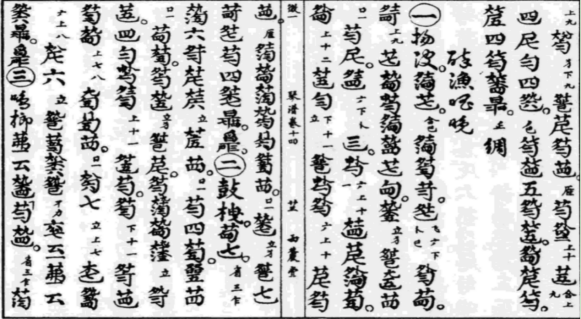
Note. From Xilutang qintong, by Z. Wang, 2010, in Qinqu jicheng (Vol. 3), Zhonghua Book Company.
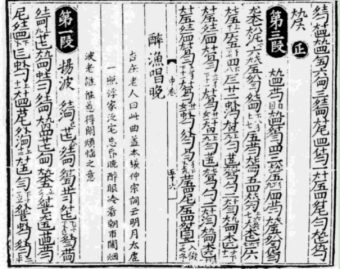
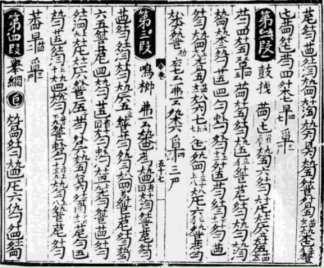
Note. From Xingzhuang taiyin buyi, by L. Xiao, 2010, in Qinqu jicheng (Vol. 3), Zhonghua Book Company.
2.2 The Establishment of a Twelve-Section Form
Dahuange Qinpu of 1673 is the source of the twelve-section Zuiyu. Its compiler, Xu Shangying, represents the late Ming Yushan tradition. This version first divides the piece into twelve sections by splitting each of the original fifth and eighth sections in two, while removing the section headings. The change reflects a shift in structural understanding from narrative divisions guided by verbal headings to instrumental divisions shaped by musical development itself. The twelve-section form subsequently became common to most versions and offers another important criterion for tracing their descent.
The fingering in Dahuange (Figure 3) is especially detailed, with close attention to the left-hand inflections yin, nao, chuo, and zhu. These include da yin, da zhuang, ji nao, da tuifu, and shuangzhuang. Although the piece remains labeled zhi yin, its opening changes from the eleventh hui position on the fourth string in Xilutang Qintong and Xingzhuang Taiyin Buyi to the tenth hui on the same string. Most subsequent collections retain this opening, until Qinxue Chujin of 1894 restores the eleventh hui. Here, hui refers to a position marker on the qin. Ling Qizhen considers the tenth-hui reading an error introduced by Dahuange. In his comparison of the two pieces called Zuiyu Changwan, he writes the following.
The Zuiyu in Xilutang Qintong uses standard tuning to play in Yize yun, avoiding the open tones of strings one, three, and six. The hui positions used for stopped tones therefore differ. Playing the eleventh hui on the fourth string as jue and the ninth hui on the fifth string as yu is customary in pieces in Yize yun. Changing the eleventh hui on the fourth string to the tenth hui disrupts the melodic progression of the entire piece. An examination of Dahuange Qinpu and subsequent collections shows that they all perpetuate this error. (Ling, 2023, p. 100)
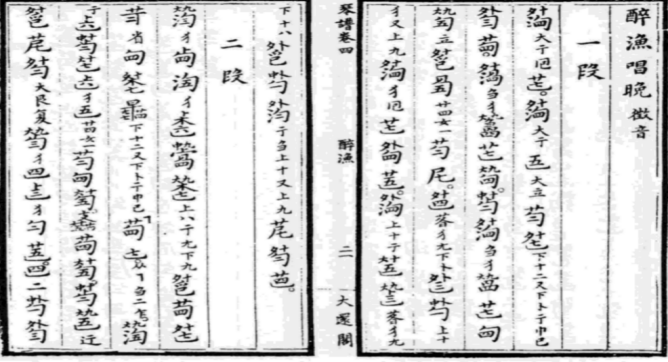
Note. From Dahuange qinpu, by S. Xu, 2010, in Qinqu jicheng (Vol. 10), Zhonghua Book Company.
2.3 Early Qing Transmission and Guangling Changes
Many Qing collections include Zuiyu after its appearance in Dahuange, with both common and divergent structural features. Most retain twelve sections without headings, including Chengyitang Qinpu of 1705, Chengjiantang Qinpu of 1718, Songfengge Qinpu of 1677, and Wuzhizhai Qinpu of 1721. Liaohuaitang Qinpu of 1702 also has twelve sections but retains early headings such as Guyi, Minglang, and Juwang. The explanatory note in Wuzhizhai attributes the piece to “later recluses” and states that it “shares tones with Yuge but differs in diao.” It also records that “the two tablatures of Master Xu Qingshan and Master Yin Zhixian were compared and combined” (Q. Xu, 2010, p. 506). By the early Qing period at the latest, compilers were deliberately comparing different versions, and multiple forms circulated concurrently.
The mid-Qing Ziyuantang Qinpu provides the direct source for the Wuxue Shanfang Zuiyu (Wu, 2010). Its version was transmitted by the Guangling musician Wu Hong and revised by Li Tingjing. Guangling performance is known for finely differentiated fingering and pronounced rhythmic fluctuation. Ziyuantang replaces such Dahuange left-hand gestures as da yin, da zhuang, shuangzhuang, and da tuifu with characteristic Guangling gestures, including shuangnao, ji zhuang, and ji nao. It also reduces sliding tones considerably, giving the piece rhythmic rise and fall while retaining an antique character. Wu's version expresses the Guangling pursuit of articulated sound and resonant inflection in equal measure. Building on the Dahuange transmission, it introduces two changes that directly shaped later versions. First, it changes the designation inherited from the Ming, zhi yin, to zhengdiao shang yin, or standard tuning with a shang final. Naming a piece by a particular diao and a particular yin follows Wang Tan's conventions in Qinzhi (T. Wang, n.d.). From the Song and Ming periods onward, qin musicians had used gong, shang, jue, zhi, and yu to designate the modes of pieces. Second, Ziyuantang creates a separately marked shouyin, or closing unit, by setting apart the harmonic passage at the end of section twelve and giving it an independent concluding function.
The twelve-section form continued across later transmission. Yiluxuan Qinpu, preserved in a manuscript copied after 1802, Yiliu Zhengwu Zhizhai of 1875, and Tianlaige Qinpu of 1876 also contain the piece. Qinxue Chujin of 1894 preserves twelve sections, but its compiler Chen Shiji proposes a different modal attribution. He identifies the piece as Taicu gong, rejecting both the zhi and shang designations as inconsistent with “the original intent of this piece” (Chen, 2010, p. 344). Shayan Qinbian of 1946, the last collection in the twelve-section transmission, retains the shang designation.
Table 1 brings together the principal versions for comparison.
Table 1: The Transmission and Development of the Lingnan Zuiyu
| Collection | Date | Sections | Tonal designation | Structure | Place in transmission |
|---|---|---|---|---|---|
| Xilutang Qintong | 1525 | 10 | — | Section headings | Earliest surviving tablature |
| Xingzhuang Taiyin Buyi | 1557 | 10 | — | Continues Xilutang | Continuation of the early Ming form |
| Dahuange Qinpu | 1673 | 12 | Zhi | First division into 12 sections; headings removed | Source of the 12-section form |
| Liaohuaitang Qinpu | 1702 | — | — | Continues the Dahuange line | Differentiation within the lineage |
| Chengyitang Qinpu | 1705 | 12 | Zhi | Continues Dahuange | Convergence within the lineage |
| Chengjiantang Qinpu | 1718 | 12 | — | Continues Dahuange | Convergence within the lineage |
| Wuzhizhai Qinpu | 1721 | 12 | Zhi | Compares and combines two tablatures | Major stage in the 12-section lineage |
| Ziyuantang Qinpu | 1802 | 12 | Shang | First change from zhi to shang; separate closing unit | Guangling revision and direct source |
| Yiluxuan Qinpu | After 1802 | — | — | Continues the Ziyuantang line | Links earlier and later versions |
| Wuxue Shanfang Qinpu | 1835 | 12 | Zhonglü yun with a shang final | Retains shang and the closing unit; Mo Jizhao's detailed revision | Formation of a Lingnan version described as untrammeled and beyond worldly concerns |
Note. A dash reproduces an unspecified entry in the source table. Tonal labels are historical designations used in the respective collections.
Modal disagreement runs throughout this transmission. The zhi designation of Xilutang Qintong gives way to shang in Ziyuantang and Wuxue Shanfang, followed by Taicu gong in Qinxue Chujin. Musicians reached no settled agreement on the piece's modal identity. Two principal stages organize its development. In 1673, Dahuange recast ten sections as twelve and removed the headings, establishing its structural form. In 1802, Ziyuantang changed zhi to shang and introduced a distinct closing unit, providing the tablature basis of the Wuxue Shanfang version.
3. The Zuiyu Version in Wuxue Shanfang
The Wuxue Shanfang Zuiyu has a distinctive style. Following its “detailed revision” by the Lingnan musician Mo Jizhao, Huang Jingxing praised it as “untrammeled and beyond worldly concerns.”
3.1 Sources of the Piece
Huang's colophon to Zuiyu in Wuxue Shanfang records the circumstances of its revision.
Mr. Mo Jizhao, also known as Lanwan, studied fingering with me under Master He Qinzhai and his son. Quick in mind and dexterous in hand, he was a friend whose qin playing commanded my respect. After his detailed revision, this piece became untrammeled and beyond worldly concerns. Regrettably, his life was short. More than thirty years have now passed, but the feeling of having known one who understood my music can never be forgotten. (Huang, 2010, p. 353)
Zhang (2022) uses this colophon to argue that Zuiyu Changwan, Gaoshan [High Mountains], Qingye Wenzhong [Hearing Bells on a Clear Night], and Yandu Hengyang [Wild Geese Passing Hengyang] all belonged to He Luoshu's family repertoire. The colophon itself records Huang and Mo's study of fingering under He Qinzhai and the “untrammeled” character produced by Mo's revision. It does not directly state that He transmitted the piece. Attribution to He Luoshu is therefore a reasonable inference from the two musicians' teaching lineage, rather than an explicit statement in the colophon. Whether the piece came directly from He Luoshu requires further examination.
The fifty pieces in Wuxue Shanfang have varied sources. Only four are explicitly identified as deriving from the Huang family's Gugang Yipu, namely Bijian Liuquan [Flowing Springs in a Verdant Ravine], Huaigu [Reflecting on Antiquity], Oulu Wangji [Gulls and Egrets Forgetting Worldly Designs], and Yuqiao Wenda. Six pieces are attributed to the father and son He Luoshu and He Wenxiang. Most of the remainder come from Jiangsu and Zhejiang collections such as Ziyuantang, alongside several versions transmitted by local teachers and friends. According to Zhang Huaying (2022), Zuiyu belongs to the He Luoshu line and thus has a different transmission from the family Gugang Yipu. This explains its presence in the Lingnan collection despite its absence from the Gugang Yipu repertoire.
3.2 The Content of the Detailed Revision
3.2.1 Fingering
The Wuxue Shanfang Zuiyu retains distinctive stopped-tone positions such as the eleventh hui, hui 10.8, and the eighth hui. Its left-hand gestures differ from Ziyuantang, which favors the distinctly Guangling shuangnao, ji nao, and ji zhuang. Wuxue Shanfang replaces these with finer gestures such as changyin and changfu, or prolonged inflection and return. It markedly reduces sliding tones compared with Ziyuantang, and still further compared with their abundance in Dahuange. The resulting spare style recalls the plain character of early Ming versions. Mo's detailed revision thus proceeded through simplification and a return to plainness, reversing the familiar expansion of traditional repertoire through added ornament. The music became restrained and free of worldly concerns, giving substance to Huang's assessment. If Dahuange represents a high point in the elaboration of resonance, Wuxue Shanfang deliberately moderates that elaboration. Its simplicity is an active stylistic choice, not a loss introduced through copying.
3.2.2 Tuning and Modal Designation
Wuxue Shanfang also revises the piece's tonal label. Where Ziyuantang gives “gong tuning, shang final,” it uses “Zhonglü yun, shang final.” Its prose discussion emphasizes “matching the seven pitch-standard tunings with the seven tunings of vernacular music,” and the title of Zuiyu carries the annotation “xiaogong tuning in vernacular music.”
Although both collections identify shang as the final, their classifications derive from different sources. Ziyuantang follows Wang Tan's Qinzhi in naming a particular diao and a particular yin. Wuxue Shanfang adopts the yun–yin terminology of Chuncaotang Qinpu. In his note to Qiaoge [Woodcutter's Song], Huang states that “Gengge, Zuiyu, and Yandu Hengyang are all appropriately designated shang yin” (Huang, 2010, p. 340). His labels therefore draw on three inherited accounts. They accept the shang attribution of Ziyuantang, adopt the yun–yin naming convention of Chuncaotang, and use the vocabulary of ti and yong, or constitutive basis and function, from Qinzhi, as in “shang establishes the basis.” Their convergence in one collection demonstrates the breadth and selective combination of Qing thinking about yun and diao.
Annotations between musical passages serve both to explain tonal organization and to communicate expression. In section one, the second phrase is marked “shang establishes the basis,” and the last phrase “closes on shang.” At the end of the third phrase in section six appears “bian gong and bian zhi”; the second phrase of section nine begins with “bian gong”; and the final harmonic passage in section twelve is marked “closing unit.” These annotations accord with the judgment that shang establishes the mode, assisted by the auxiliary tones bian gong and bian zhi. Expressive directions include “the resonance accords with drunkenness” at the opening of section five and “a fluctuating close” at the end of section ten. A small-print note in section eleven reads, “This section is ethereal and mobile, without traces of antiquity.” It invokes the lines “Floating clouds and willow catkins have no roots; through the vast expanse of heaven and earth they drift with the wind,” conveying lightness and freedom. “Shang establishes the basis” follows Wang Tan's formulation in Qinzhi that “shang yin takes the shang tone as its constitutive basis,” while “the resonance accords with drunkenness” echoes the colophon's “untrammeled and beyond worldly concerns.” The editor thus joins explicit musical reasoning to the communication of expressive meaning.
The early designation of Zuiyu as zhi yin belongs to the tradition of naming modes by the five tones, gong, shang, jue, zhi, and yu, established from the Song dynasty onward. Already in the Song, however, musicians encountered the pattern described as “shang and zhi reversed, and jue attached to gong.” Ding Chengyun (2003) argues that pieces labeled shang and zhi from the Song onward were actually gong-mode pieces produced in standard tuning by avoiding particular open strings. This allowed a change of mode without retuning. Only the gong and yu labels consistently matched the actual modes. Ming practice inherited the five-tone naming tradition, explaining the zhi designation from Xilutang onward. Confusion in qin naming led to errors in modal classification across collections. During the Qing revival of antiquarian learning, writers sought to reorganize qin tunings through the twelve pitch standards. Representative works include Wang Tan's Qinzhi, Wang Shan's Qinxue Lianyao, and Su Jing and colleagues' Chuncaotang Qinpu. They replaced conventional names for string tunings inherited from Song and Ming practice, including zhengdiao, ruibin diao, qingshang diao, manjue diao and mangong diao, with pitch-standard designations. Qinzhi instead used gong, shang, jue, zhi, and yu for tuning categories and added a particular yin to identify a piece's mode. Thus Ziyuantang labels Zuiyu “gong tuning, shang final,” while Wuxue Shanfang uses “Zhonglü yun, shang final.” In each label, the first element identifies the tuning, namely standard tuning with the third string as gong, and the second the mode. Both collections therefore identify Zuiyu as shang on the basis of standard tuning. If the piece is instead understood as borrowing another tonal arrangement by avoiding the open tones of strings one, three, and six and making the fourth string gong, it becomes a gong-mode piece. This explains the change to gong in Qinxue Chujin.
The modal debates surrounding the Lingnan Zuiyu thus record historical changes in Chinese qin tuning thought and the influence of elite and vernacular classifications on judgments about a piece's mode.
4. Conclusion
The Lingnan and Sichuan Zuiyu share a title but differ in melodic organization, structure, and aesthetic style. They are distinct pieces bearing the same name. The Lingnan piece developed through successive revisions into an identifiable transmission of its own. Comparison of Ming and Qing tablatures clarifies its sources, stylistic qualities, and musical thought, which previous research has seldom examined closely. Its earliest appearance is in Xilutang Qintong. Three stages shaped its development. Dahuange first established twelve sections; Ziyuantang revised its tonal designation; and Mo Jizhao's detailed revision in Wuxue Shanfang gave it a representative Lingnan form. Mo simplified the music and returned its style to plainness, realizing Huang's description of it as “untrammeled and beyond worldly concerns.” The annotations communicate both tonal reasoning and expressive meaning. They also record concrete Qing practices of distinguishing yun from diao and examining elite and vernacular musical knowledge together. Tracing this piece clarifies the differentiation of tablatures, the practice of musical classification, and changes in aesthetic preference, allowing a focused case to illuminate the historical transformation of guqin music.
Competing Interests
The authors declare no competing interests.
Fund Program
This article is one of the final outputs of A Study of the Zhonglü Yun Qin Repertoire in the Lingnan School's Wuxue Shanfang Qinpu (GD22LIN10), a Lingnan Project of the Guangdong Federation of Social Sciences.
References
- [1]
Chen, S. (2010). Qinxue chujin [First steps in qin learning]. In Institute of Music, Chinese National Academy of Arts, & Beijing Guqin Research Association (Eds.), Qinqu jicheng [Collected qin tablatures] (Vol. 28). Zhonghua Book Company.
- [2]
Ding, C. (2003). Lun wuyin diao qindiao suyuan zhi er [On the five-tone modes, the origins of qin tunings, part two]. Music Art, (2), 70–77.
- [3]
Huang, J. (2010). Wuxue shanfang qinpu [Qin tablatures from the Wuxue Mountain Studio]. In Institute of Music, Chinese National Academy of Arts, & Beijing Guqin Research Association (Eds.), Qinqu jicheng [Collected qin tablatures] (Vol. 22). Zhonghua Book Company.
- [4]
Ling, Q. (2023). Qiusheng qinguan yigao [Posthumous writings from the Autumn Sound Qin Studio]. Chongqing Publishing House.
- [5]
Wang, T. (n.d.). Qinzhi [Principles of the qin]. Wenyuange edition of the Siku Quanshu.
- [6]
Wang, Z. (2010). Xilutang qintong [Qin compendium of the Western Foothill Hall]. In Institute of Music, Chinese National Academy of Arts, & Beijing Guqin Research Association (Eds.), Qinqu jicheng [Collected qin tablatures] (Vol. 3). Zhonghua Book Company.
- [7]
Wu, H. (2010). Ziyuantang qinpu [Qin tablatures of Ziyuantang]. In Institute of Music, Chinese National Academy of Arts, & Beijing Guqin Research Association (Eds.), Qinqu jicheng [Collected qin tablatures] (Vol. 17). Zhonghua Book Company.
- [8]
Xiao, L. (2010). Xingzhuang taiyin buyi [Xingzhuang's supplementary qin tablatures]. In Institute of Music, Chinese National Academy of Arts, & Beijing Guqin Research Association (Eds.), Qinqu jicheng [Collected qin tablatures] (Vol. 3). Zhonghua Book Company.
- [9]
Xu, Q. (2010). Wuzhizhai qinpu [Qin tablatures of Wuzhizhai]. In Institute of Music, Chinese National Academy of Arts, & Beijing Guqin Research Association (Eds.), Qinqu jicheng [Collected qin tablatures] (Vol. 14). Zhonghua Book Company.
- [10]
Xu, S. (2010). Dahuange qinpu [Qin tablatures of Dahuange]. In Institute of Music, Chinese National Academy of Arts, & Beijing Guqin Research Association (Eds.), Qinqu jicheng [Collected qin tablatures] (Vol. 10). Zhonghua Book Company.
- [11]
Zhang, H. (2022). Huang Jingxing Wuxue shanfang qinpu tankui [An inquiry into Huang Jingxing's Wuxue Shanfang Qinpu]. Journal of Xinghai Conservatory of Music, (2), 25–42.